
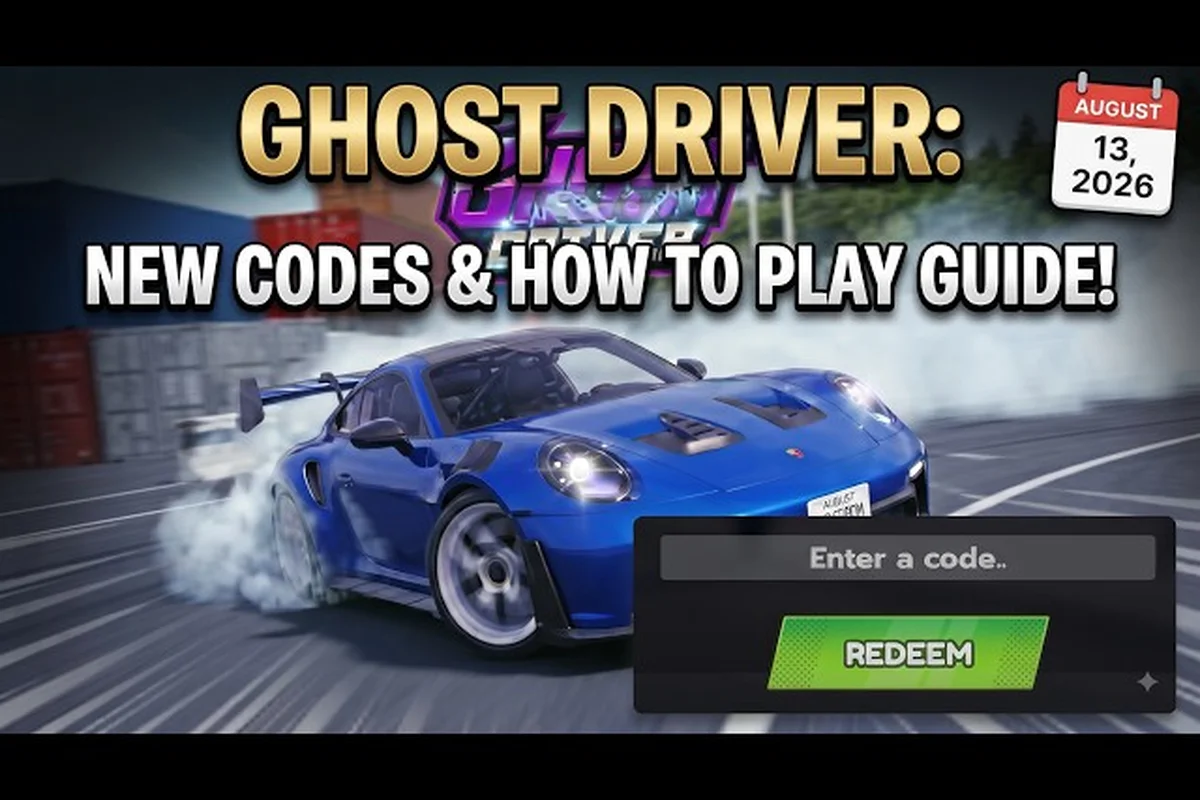
If you just launched Ghost Driver and feel lost on the highway, this help guide walks you through the traffic-cutting loop from your first spawn to your first supercar. The game drops you into a pre-alpha highway with one goal: swerve through heavy traffic at insane speeds while building a Cash bankroll. Because every second of hesitation costs you combo potential, understanding the core systems before your first run matters more than raw reflexes. This walkthrough covers controls, the dealership, upgrade priorities, and the habits that separate drivers who grind for hours from those who quit after ten minutes.
Ghost Driver Tutorial: First Spawn and Core Controls
Your first session starts on a highway with a stock car and zero instructions beyond the basic keybindings. The official Ghost Driver page on Roblox lists the essentials: W/A/S/D or Arrow Keys to steer, V to switch camera, Shift for handbrake or drift, and L for headlights. Memorize those four inputs before you chase traffic, because fumbling for keys mid-run is the fastest way to wreck.
Most players report that the default camera angle feels uncomfortable for the first few minutes, so press V immediately and test both views. Third person gives you a wider sightline for reading gaps between cars, while first person helps you judge distance when you're threading tight lanes. Pick whichever feels stable and stick with it for your first ten runs, because constantly toggling views keeps your brain busy when it should be processing traffic patterns.
Your first goal is simple: survive a full highway stretch without crashing. Focus on maintaining a steady speed rather than redlining everywhere, because the game rewards clean runs with consistent combo multipliers. A single crash resets your multiplier to zero, which means ten seconds of reckless driving can erase three minutes of careful lane work. When you feel comfortable with the controls, move on to the dealership and buy your first upgrade.
Camera View Selection
The V key camera toggle is the single most impactful control for new drivers, since it changes how you perceive depth and speed. Third person reveals more of the highway ahead, letting you spot braking cars earlier and plan lane changes with extra reaction time. First person feels faster and more immersive, but your peripheral awareness drops significantly. Community testing suggests that roughly 70% of new players perform better in third person during their first hour, because the wider field of view reduces panic-induced misinputs.
Handbrake and Headlight Usage
The Shift handbrake is not just for drifting, it is your emergency avoidance tool when a car suddenly brakes in front of you. Tap it briefly to shift your car's weight and change direction quickly, but avoid holding it, since that sends you into a spin that is harder to recover from. The L headlight toggle matters more than you expect, because night sections reduce visibility and make it harder to spot dark-colored vehicles until they fill your windshield. Flip them on at the start of every run and leave them on, since there is no penalty for running lights during the day.
A Full Walkthrough: From First Cash to First Car
The progression loop revolves around Cash accumulation through active racing, because every near-miss and clean lane change feeds your combo multiplier. Your run ends when you crash, at which point the game converts your accumulated combo score into Cash based on distance and difficulty. The dealership then turns that Cash into faster cars and upgraded parts, which let you survive longer runs and earn even more money.
| Car Type | Average Cost | Best For | Risk Level |
|---|---|---|---|
| Starter Coupe | Free | Learning traffic reading | Low |
| Sports Sedan | 15,000–25,000 Cash | Consistent mid-tier runs | Medium |
| Muscle Car | 30,000–50,000 Cash | High-speed straightaways | High |
| Supercar | 75,000+ Cash | Maximizing combo multipliers | Very High |
The dealership rotation changes which cars are available, so check it every time you accumulate enough Cash for a purchase. You can also earn bonus Cash through redemption codes that the developer releases on social media, which we cover in the full ghost driver guide for players who want to stack rewards efficiently.
Your first purchase should always be a handling upgrade rather than a new car, because the stock vehicle's weak brakes cause most early crashes. A suspension upgrade improves cornering stability, letting you take sharper angles without losing control. Once you can complete three consecutive clean runs in the sports sedan, start saving for the supercar tier, since those vehicles offer the acceleration needed for high-risk, high-reward maneuvers.
Reading Traffic for Maximum Combo Build
Successful runs depend on predicting traffic patterns rather than reacting to them, because at high speeds you have less than a second to decide. Watch for brake lights two or three cars ahead, since they signal a slowdown that will ripple through the lane. Trucks and buses occupy more space and require wider berths, while motorcycles slip through gaps that sedans cannot fit through. Veteran players describe this as "reading the river," because traffic flows like water around obstacles and you need to position yourself where the current moves fastest.
The Cash Conversion Formula
Your run earnings follow a simple formula: distance traveled × combo multiplier × difficulty bonus. The combo multiplier increases with each near-miss, capped at a value that depends on your car tier and current upgrades. Higher-tier cars have higher caps but also demand cleaner driving, because their speed makes mistakes more punishing. If you crash early, you lose both the multiplier and the distance bonus, which is why consistency beats raw aggression for building your first 50,000 Cash.
Proven Tips for Finishing Runs Consistently
New players who focus on survival rather than speed consistently earn more Cash per hour, because their runs last longer and their multipliers climb higher. The over-speed trap is the most common killer: pushing full throttle into every straightaway feels exciting but leaves no room for correction when traffic shifts. Instead, modulate your throttle in sections where cars cluster, then accelerate through clear stretches.
-
Brake before corners, not during them: downshift or tap the brake while the car is still straight, then steer through the turn with steady throttle.
-
Never tailgate: maintain at least two car lengths of space, because the car ahead may brake suddenly and leave you no escape route.
-
Use the full highway width: stay near lane edges to create extra reaction space when a car swerves unexpectedly.
-
Take breaks between runs: fatigue causes tunnel vision, and a 60-second rest prevents the careless crashes that drain your Cash.
The near-miss detection system rewards risky passes with extra combo points, but the risk-reward tradeoff is heavily skewed toward survival. A near-miss adds roughly 15% to your multiplier, while a crash resets it to zero, which means you need seven successful near-misses just to break even on one mistake. For beginners aiming to build their first garage, the ghost driver how to play guide breaks down the exact risk calculations that advanced players use to decide when to push and when to brake.
Optimal Upgrade Order for Cash Efficiency
Your upgrade path should follow a specific sequence to maximize Cash efficiency. Start with brakes, since stopping power directly reduces crash frequency. Next comes suspension for cornering stability, followed by engine upgrades that improve acceleration. Transmission upgrades come last, because top speed is useless if you cannot control the car at lower velocities.
| Upgrade | Cost Range | Impact | Priority |
|---|---|---|---|
| Brake Pads | 5,000–8,000 | Reduces stopping distance | 1st |
| Suspension Kit | 8,000–12,000 | Improves cornering stability | 2nd |
| Engine Tuning | 10,000–15,000 | Boosts acceleration | 3rd |
| Transmission | 15,000–20,000 | Raises top speed | 4th |
Building a Practice Routine
A structured practice routine accelerates your learning curve dramatically, because it isolates specific skills instead of hoping you improve through osmosis. Spend your first five runs practicing brake timing without worrying about combo scores. The next five should focus on lane changes, deliberately weaving through sparse traffic to build muscle memory. Only after those ten runs should you attempt full-speed combo runs, since by then your hands know the controls well enough to let your eyes focus on the road.
Advanced Techniques for Sustained Combo Chains
Once you master the basics, the next step is chaining near-misses together to maintain a continuous combo multiplier across the entire highway. The key insight is that your multiplier decays after about five seconds without a near-miss, so you need to constantly seek out traffic gaps rather than cruising in open lanes. This creates a constant tension between risk and reward, which is exactly what makes the game engaging.
The drift-to-combo transition is an advanced technique where you use the handbrake to slide through a corner and carry that momentum into the next traffic gap. This technique requires precise timing, because a poorly executed drift leaves you facing the wrong direction with no escape route. Players who master it report 30–40% higher combo scores on average, according to community data shared in the official Discord. For a deeper breakdown of the slide mechanics, the ghost driver drift guide covers the input timing and car setups that make sustained drifting viable.
Handling Traffic Clusters
Traffic tends to cluster in groups of three to five vehicles, often with a slow-moving truck at the front holding up a line of cars. The optimal strategy is to overtake the entire cluster in one pass, since that gives you multiple near-miss opportunities in quick succession. Approach the cluster from the rear, pick a gap between two vehicles, and accelerate through it while maintaining enough speed to clear the truck at the front. This technique carries risk, because a misjudged gap leaves you sandwiched between vehicles with no escape route, but the combo payoff is substantial.
Managing Run Length for Cash Efficiency
Longer runs do not always mean more Cash, because fatigue increases your crash probability and a late-game crash wastes all the time you invested. Community reports suggest that the sweet spot is roughly three to five minutes per run, depending on your skill level. If you are still earning consistent Cash at the five-minute mark, push further, but if your concentration starts slipping, end the run deliberately by pulling to the shoulder rather than risking a crash that resets your multiplier.
Common Mistakes That Drain Your Cash
Even experienced drivers fall into patterns that quietly eat away at their earnings, and identifying these mistakes early saves you thousands of Cash. The most common issue is over-upgrading one stat while neglecting others, which creates a car that is fast in a straight line but impossible to control in corners. Another frequent error is chasing the newest car instead of upgrading what you already own, since a fully upgraded mid-tier car outperforms a stock supercar in most situations.
The panic-brake reflex is also a major Cash drain, because slamming the brakes at the first sign of trouble often causes a spin that leads to a crash. Instead of braking hard, practice lift-and-steer: take your foot off the throttle, steer around the obstacle, then accelerate once you are clear. This technique takes time to internalize, but it dramatically reduces crash frequency once it becomes automatic.
The Upgrade Resale Trap
Some players trade in their upgraded cars for newer models, only to realize that upgrades do not transfer and the resale value is a fraction of what they invested. Before you buy a new car, calculate whether the performance gain justifies losing all the upgrade value in your current vehicle. In most cases, it is better to keep your upgraded car and save for the next tier rather than making incremental purchases that reset your progress.
Ignoring the Daily Bonus
The game offers a daily login bonus and periodic event rewards that many players overlook while grinding for Cash. These bonuses add up quickly, and during special events they can double your earnings for specific activities. Check the game page and official social channels regularly to stay informed about active bonuses, because a five-minute check can save you an hour of grinding.
Ghost Driver Tips for Night Driving
Night sections change the game's difficulty significantly, because reduced visibility makes traffic harder to spot and distance harder to judge. The headlight toggle becomes essential, but even with lights on, dark-colored vehicles can blend into the road surface until you are almost on top of them. Slow down slightly during night sections and rely more on your peripheral vision to catch movement at the edges of your sightline.
| Time of Day | Visibility | Recommended Speed | Risk Adjustment |
|---|---|---|---|
| Day | Full | Max | Standard |
| Dusk | Moderate | 80% of max | Slightly cautious |
| Night | Limited | 60–70% of max | High caution |
The night speed penalty is worth accepting, because the extra reaction time prevents crashes that would cost far more than the reduced combo multiplier. If you find night runs consistently ending in crashes, consider switching your play schedule to day sections until your traffic-reading skills improve. The game does not force you into night runs, so optimizing your play conditions is a legitimate strategy for maximizing Cash.
Frequently Asked Questions
What is the fastest way to earn Cash in Ghost Driver?
Active racing with consistent combo multipliers is the fastest method, because it generates Cash continuously without relying on external rewards. Focus on completing clean three-to-five-minute runs rather than risky high-speed attempts, since a crash resets your multiplier and wastes all the time you invested. Redemption codes provide bonus Cash but are limited by availability.
How do I unlock better cars in Ghost Driver?
Better cars appear in the dealership rotation as you accumulate Cash and complete runs. The dealership refreshes periodically, so check it regularly for new vehicles. Purchasing a car requires enough Cash to cover the listed price, and higher-tier cars cost significantly more. The starter coupe can carry you through early progression if you prioritize upgrades over car purchases.
What upgrades should I buy first in Ghost Driver?
Brake upgrades should come first, since stopping power directly reduces crash frequency and extends your run length. Suspension upgrades come second for cornering stability, followed by engine tuning for acceleration. Transmission upgrades are last because top speed is useless without control. This order maximizes your Cash efficiency by addressing the most common crash causes first.
Is drifting necessary for high scores in Ghost Driver?
Drifting is not required for high scores, but it helps maintain combo multipliers through corners where you would otherwise need to brake. The handbrake drift technique allows you to carry speed through turns while collecting near-miss bonuses from passing traffic. Beginners should focus on clean steering first, then add drifting once they can consistently complete runs without crashing.
How do I avoid crashes during night sections in Ghost Driver?
Reduce your speed to roughly 60 percent of your maximum during night sections and rely more on peripheral vision to spot dark-colored vehicles. Keep your headlights on at all times, since toggling them mid-run wastes attention that should go to traffic reading. If night runs consistently end in crashes, switch to day sections until your skills improve.